- Can you tell us about your academic background to date and what led you to choose this field of research?
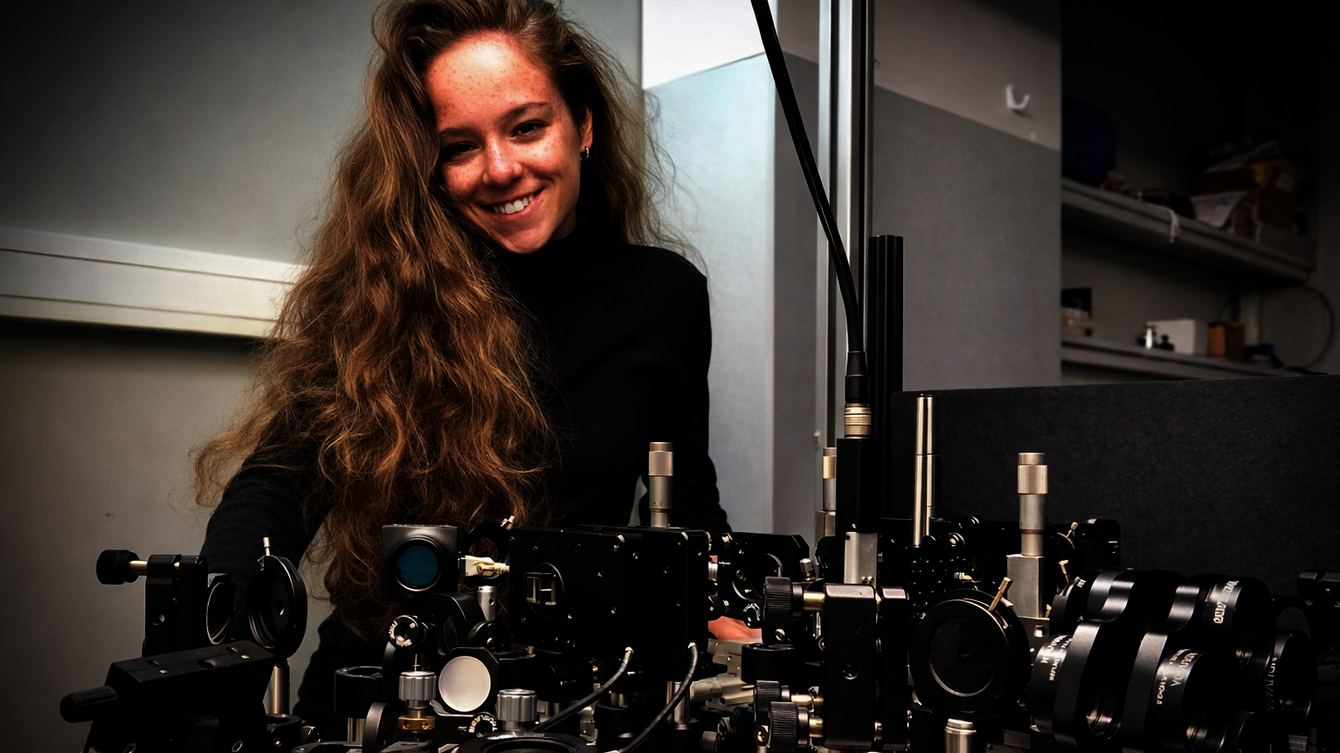
After two years of preparatory classes, I joined the chemistry department at École Normale Supérieure Paris-Saclay in 2021, from which I recently graduated, while also pursuing a Master's degree in Inorganic, Physical, and Solid-State Chemistry at Paris-Saclay University. My career path has always been guided by curiosity and fascination with light-matter interactions. I first became interested in organic chemistry and photochemistry when I discovered how light can control chemical reactivity at the ENS in Lyon with Dr. Laure Guy and Dr. Marine Labro. I then explored these interactions from a theoretical and modeling perspective at the Institut de Chimie Physique in Orsay under the supervision of Dr. Federica Agostini. Then, between 2023 and 2024, I completed a pre-doctoral research year at the Physikalisch-Chemisches Institut (PCI) at the University of Heidelberg under the supervision of Prof. Dr. Petra Tegeder, where I studied the nonlinear optical properties of chiral diradical molecules, which reinforced my interest in chirality. Back in France, my master's thesis ultimately focused on three-dimensional chiroplasmonic assemblies, which I carried out at the Laboratoire de Photophysique et Photochimie Supra- er macromoléculaires (PPSM) under the supervision of Dr. Guillaume Laurent.
Today, the thesis project I am conducting with Dr. Cyriaque Genet explores the effects of absorption, emission, and chiroptyc nonlinearities of chiral molecule-cavity coupling. This ambitious project is a coherent synthesis of my career path to date, as it integrates all the dimensions of my background: molecular systems, chirality, nonlinear optics, and strong light-matter coupling.
- What does the research environment at ISIS offer (professionally and personally)?
The research environment at ISIS is both scientifically stimulating and personally enriching, thanks to its strong interdisciplinary approach. As a chemist supervised by a physicist and working alongside colleagues trained in physics, I am often confronted with different ways of thinking. This diversity, which sometimes leads to amusing misunderstandings, encourages me to refine my thinking, my communication, and the very design of my experiments. This diversity is also reflected in the international dimension of the laboratory, as we have the opportunity to work on a daily basis with researchers trained in various academic systems and shaped by different cultures, which is very enriching on a human level. Professionally, the environment offered by ISIS allows us to be completely autonomous while benefiting from exchanges with experts in different fields and access to advanced tools and platforms. But what really makes the difference is probably the intellectual atmosphere. ISIS is truly a place where exploring bold ideas seems almost natural. A discussion over coffee or an exchange in the hallway can easily turn into a new experimental idea. One detail that struck me from my very first days was the presence of blackboards on the walls of the hallways. I love this because it sends the message that no idea, no explanation, no intuition should ever be lost simply because there was no space to write it down!
What are your wishes for your future career ?
In the short term, I want to continue to thrive in my current research and collaborations. In the longer term, I would like to build a career at the interface between physics and chemistry, continuing to explore light-matter interactions. I would also like to incorporate mentoring into my career, as I greatly value passing on knowledge, curiosity, and scientific rigor. This commitment would be a natural continuation of my current involvement with the national office of the Young Network of the French Chemical Society (RJ-SCF), where I try to contribute in my own small way to the dynamism and promotion of our scientific community.
More generally, I hope to build a career where I can remain bold in my scientific choices because I believe that innovation requires courage: the courage to explore unconventional ideas and cross disciplinary boundaries. And I believe I am a courageous person!
What do you like about your life in Strasbourg & in Alsace?
Strasbourg is a pleasant city to live in, with a dynamic research ecosystem, while remaining relatively small and quiet. I particularly enjoy running along the Ill River or in the historic center on weekends. Originally from Haute-Savoie, I must admit that I am used to being surrounded by mountains—so the Vosges don't quite rival the Alps! But they offer just enough elevation to take your mind off things.
I had never visited Alsace before arriving in Strasbourg, and I must say that it has a unique cultural identity, particularly due to its location at the crossroads between France and Germany. I find it quite inspiring to live in a place where cultures blend in this way.
If you had to name the thing you are most proud of (in your career or personal life), what would it be?
I think I would say graduating from the École Normale Supérieure. As philosophical as it may sound, this degree is not just the result of long hours of work; for me, it symbolizes a deep conviction that I have always held. What makes this achievement so special is the journey I took to get there. On several occasions, my ability to enter the ENS was called into question. Yet I never gave up.
When I finally achieved this dream, I realized that it was not just an accomplishment, but a source of strength that I could draw on in difficult times. This experience taught me that even after achieving your goals, it is crucial to remember the courage they required, the tenacity they shaped, and the inspiration they continue to bring.
Obtaining this degree was therefore much more than an academic achievement. Those four years profoundly transformed me, both scientifically and personally, and I emerged from them fully fulfilled. Today, what makes me happy is that, in a way, I have managed to embody and become the person that my preparatory class self dreamed of becoming: a version of herself capable of dreaming big... and daring to achieve it.
![[Translate to English:] Fondation Jean-Marie Lehn](/websites/_processed_/9/4/csm_logo-fondation-lehn_24043a5484.png)
![[Translate to English:] ITI SysChem](/websites/_logos/signature-iti-syschem.svg)
![[Translate to English:]](/websites/_processed_/7/4/csm_signature-federation-chimie-uar2042_8414e733c6.png)
![[Translate to English:]](/websites/_processed_/8/8/csm_logo-europe_567626666f.jpg)
![[Translate to English:]](/websites/_processed_/e/0/csm_logo-grand-est_d7796e66f0.png)